
FROM THE ADMINISTRATOR: The incomparable BCBP Kalibo Chapter Head Gerome Quimpo is back with a detailed reflection and guide for organizing and participating in a community “Praise and Worship” or similar prayer assembly. He writes with a critical evaluation of existing practices regarding worship leaders and music ministry while advocating for a shift from a performance-based style to a more participative model. His article outlines the characteristics of an effective assembly, emphasizing the importance of shared roles, proper physical setup (like a circle configuration), and the active contribution of all members, contrasting this with less ideal, leader-focused formats. A significant portion of his writing is dedicated to explaining various elements of the prayer meeting, including worship, listening to God’s word, prophecy, speaking in tongues, visions, sharing, and teaching, along with instructions on discerning and utilizing these spiritual gifts correctly within the community. His overall focus is on fostering a communal, spiritually rich, and discerning environment where all participants are encouraged to contribute to the edification of the group. – Max P. Ereño, Jr., Kalibo, Aklan, November 22, 2025
Introduction: The Vision for Participatory Worship
Leading a prayer meeting is more than a function; it’s a sacred trust. This guide is for those who want to move beyond simply running a meeting to facilitating a genuine encounter with God. The primary focus of a chapter prayer assembly is profound yet simple: to be a formal presentation of the community before God. The goal of this manual is to provide a comprehensive framework for leading meetings that are deeply participatory, spiritually alive, and centered on encountering God’s presence. We will move beyond the mindset of performance and into the heart of genuine community worship, where every member is an active contributor, not a passive spectator.
This guide will equip you with the essential knowledge and practical tools to lead with confidence and spiritual sensitivity. We will explore the foundational principles that define a prayer assembly, clarify the key roles of leaders and members, detail how to structure the meeting for maximum engagement, provide direction for navigating the manifestation of spiritual gifts, and highlight common pitfalls to avoid.
1. The Foundational Principles of a Prayer Assembly
To lead effectively, you must first understand the “why” behind the prayer assembly. A clear vision of its purpose is the bedrock upon which every successful meeting is built. When leaders and members share a common understanding of their gathering’s identity and objective, the meeting can move from a simple routine to a dynamic encounter with the living God.
1.1. Defining the Prayer Assembly
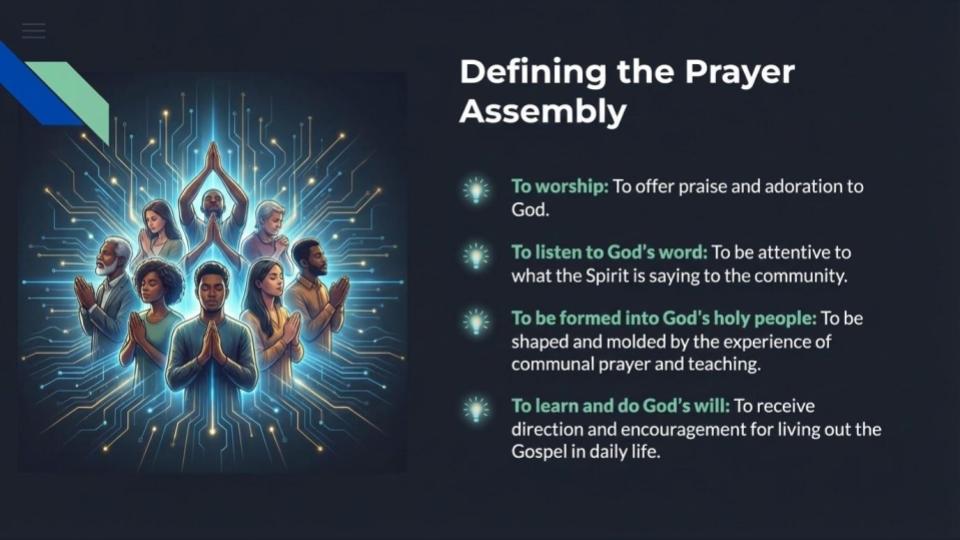
At its core, a prayer assembly is a gathering where people come together specifically to pray. It is the community formally presenting itself before the Lord. Its purpose is multifaceted and transformative:
- To worship: To offer praise and adoration to God.
- To listen to God’s word: To be attentive to what the Spirit is saying to the community.
- To be formed into God’s holy people: To be shaped and molded by the experience of communal prayer and teaching.
- To learn and do God’s will: To receive direction and encouragement for living out the Gospel in daily life.
1.2. The Core Principle: Active Participation
A prayer assembly is fundamentally participatory. It is not a service to be consumed but an act of worship to be co-created. The expectation is that everyone present will contribute, because all are gifted by the Holy Spirit. This principle is rooted in the scriptural understanding of the Church as a body where each part has a vital role to play.
The Apostle Paul provides the guiding instruction for this model of worship: “What then shall we say, brothers and sisters? When you come together, each of you has a hymn, or a word of instruction, a revelation, a tongue or an interpretation. Everything must be done so that the church may be built up.” (1 Corinthians 14:26). The ultimate measure of any contribution is whether it serves to build up the community.
1.3. Distinguishing Between Effective and Ineffective Assemblies
The difference between a life-giving prayer meeting and a stagnant one often comes down to this principle of participation. A clear contrast exists between an assembly that empowers its members and one that renders them passive.
| A Bad Prayer Assembly | A Good Prayer Assembly |
| The worship leader does most of the praying and talking, and the congregation comes to depend on them. | The leader facilitates worship in a way that encourages and empowers active participation from the entire community. |
| The Music Ministry takes over and draws attention to itself, turning worship into a performance. | The Music Ministry understands its role is to support the assembly’s worship, not to perform for it. |
| The dynamic makes people passive observers, positioned to “receive something” rather than to give. | The environment is structured to facilitate active giving and sharing of spiritual gifts from every member. |
| The focus is on the leader or musicians, creating a passive audience instead of an active body of Christ. | The focus is on the Lord, and all members work together to praise, listen, and build one another up in faith. |
Understanding these foundational principles is the first step. The next is to examine the specific people who bring these principles to life through their dedicated roles.
2. Key Roles and Responsibilities
A successful prayer assembly is not the work of a single individual but a collaborative effort where key people understand and fulfill their specific roles. A clear division of responsibility ensures that the meeting runs smoothly and achieves its purpose of bringing the community before God. This section will clarify the distinct responsibilities of the Chapter Head, the worship leader, the assembly members, and the planning team.
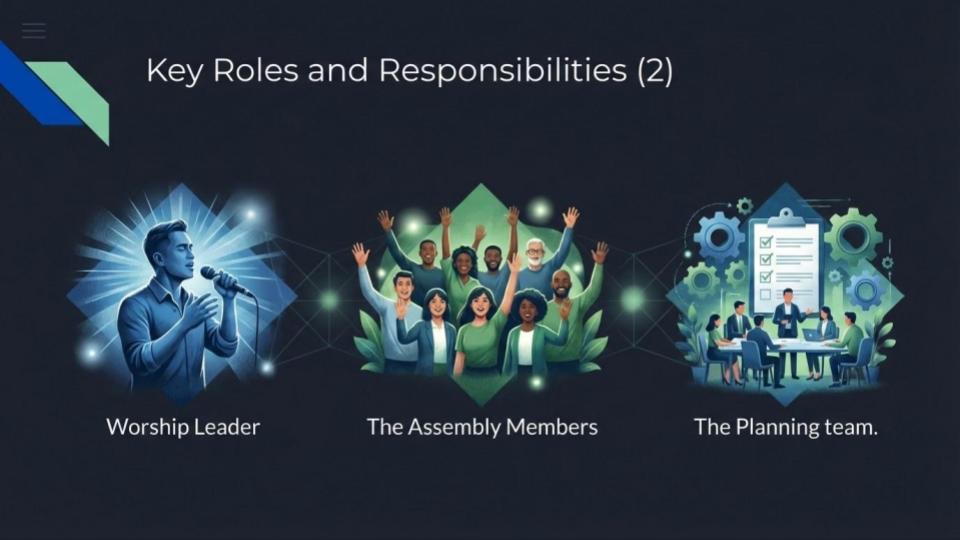
2.1. The Worship Leader: A Facilitator, Not a Performer
The worship leader is a crucial facilitator whose success is measured not by their visibility but by the engagement of the assembly. A good leader guides the prayer, but never dominates it.
- Clear Focus: The leader’s primary and unwavering focus is the praise and worship of the Lord. They are there to point to God, not to draw attention to themselves.
- Spiritual Sensitivity: The leader knows the Holy Spirit and understands that the Spirit gives gifts to everyone in the meeting. They are attentive to the Spirit’s movement and create space for those gifts to be shared.
- Encourages Participation: The leader actively knows how to get people to participate and contribute. They use their words and actions to invite others into the flow of worship.
- Empowers the People: The leader makes the meeting an event of the people and for the people. Their goal is to empower the assembly to offer its own praise to God.
- Servant Posture: The leader remains in the background as much as possible. They facilitate, guide, and serve, but they never take over the role of the participants.
- The overall meeting leader (Chapter Head) acts as the main guide for the assembly, the “Moses of his Israel.” He (and ideally with his spouse) shall ensure that everything is done in good order. If a contribution seems off-track or unhelpful, they will gently guide the meeting’s focus back to the Lord. They may also provide the short teaching for the day.
2.2. The Assembly Member: An Active Participant
Every member of the assembly has a responsibility to contribute to the life of the prayer meeting. This responsibility begins long before the meeting starts and continues throughout the gathering. Widely considered then are the following:
Before the Meeting
A good member prepares spiritually to be an active contributor.
- Come prepared for the meeting: This involves more than just showing up on time. It is a state of spiritual readiness.
- Seek God’s mind for the meeting: Spend time in personal prayer, asking what God might want to say or do in the community.
- Offer oneself to be used by God: Adopt a posture of availability, willing to share a scripture, a word of encouragement, or a prayer.
- Intercede for the meeting: Pray for the leaders, the music ministry, and all who will attend, asking the Holy Spirit to move powerfully.
During the Meeting
Once the meeting begins, the member’s role is to engage fully.
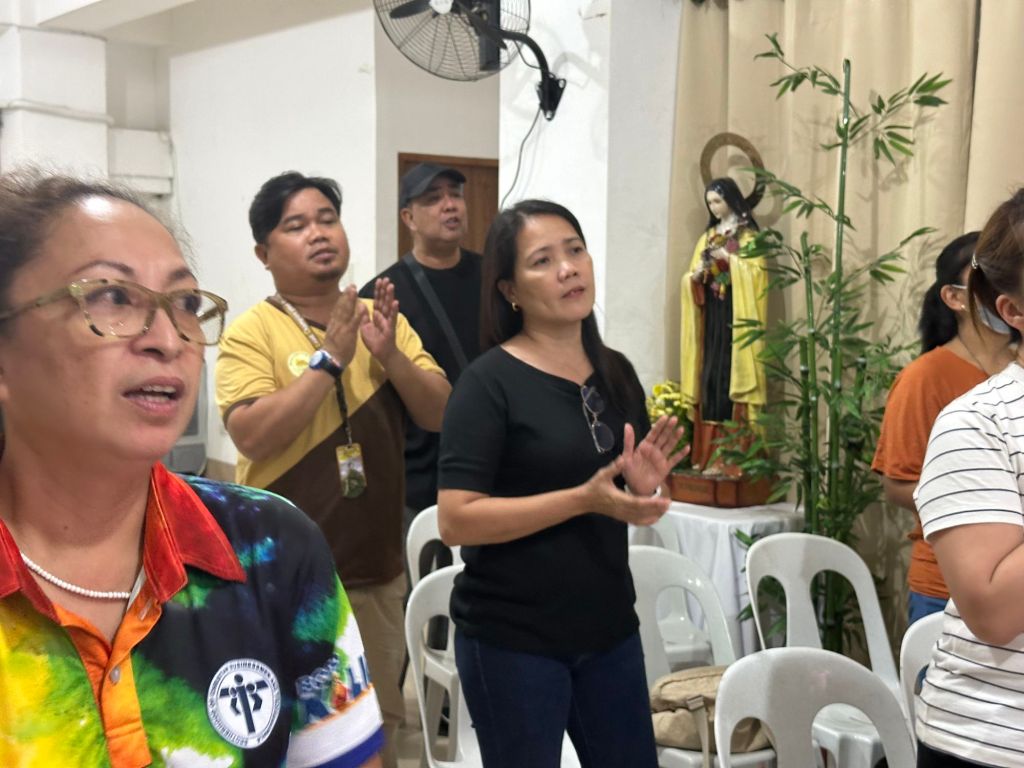
- Actively participate: Join in the singing, pray with conviction, and listen attentively to what is being shared.
- Make oneself available to the Lord: Remain open to the Holy Spirit’s prompting to share a gift for the building up of the community.
2.3. The Prayer Assembly Team: The Steering Committee
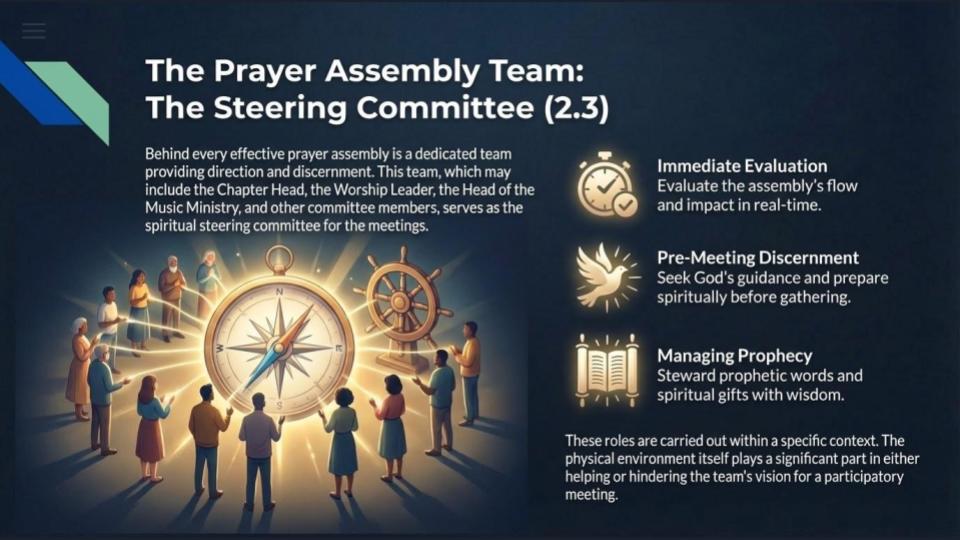
Behind every effective prayer assembly is a dedicated team providing direction and discernment. This team, which may include the Chapter Head, the Worship Leader, the Head of the Music Ministry, and other committee members, serves as the spiritual steering committee for the meetings.
Their critical functions are timed strategically:
- Immediate Evaluation: Meeting immediately after an assembly to discern what the Spirit accomplished and identify areas for improvement.
- Pre-Meeting Discernment: Meeting before the next assembly to specifically seek and set God’s will and topic for the upcoming gathering.
- Managing Prophecy: This is the team’s most important function. It involves the careful discernment of prophecies given during the meeting to understand their meaning and determine if a specific response from the community is called for.
These roles are carried out within a specific context. The physical environment itself plays a significant part in either helping or hindering the team’s vision for a participatory meeting.
3. Structuring the Environment for Engagement
The physical and atmospheric setup of a prayer meeting is not a neutral detail; it is a powerful statement about the meeting’s values. The layout of the room and the explicit instructions from the leader either encourage or discourage the core principle of participation. This section provides practical guidance on creating an environment that fosters community engagement and makes the vision for shared worship a reality.
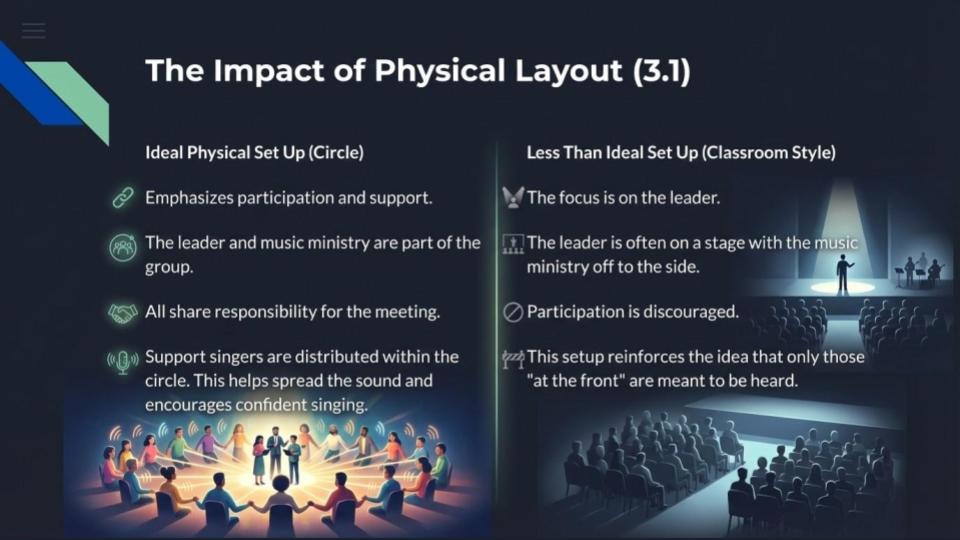
3.1. The Impact of Physical Layout
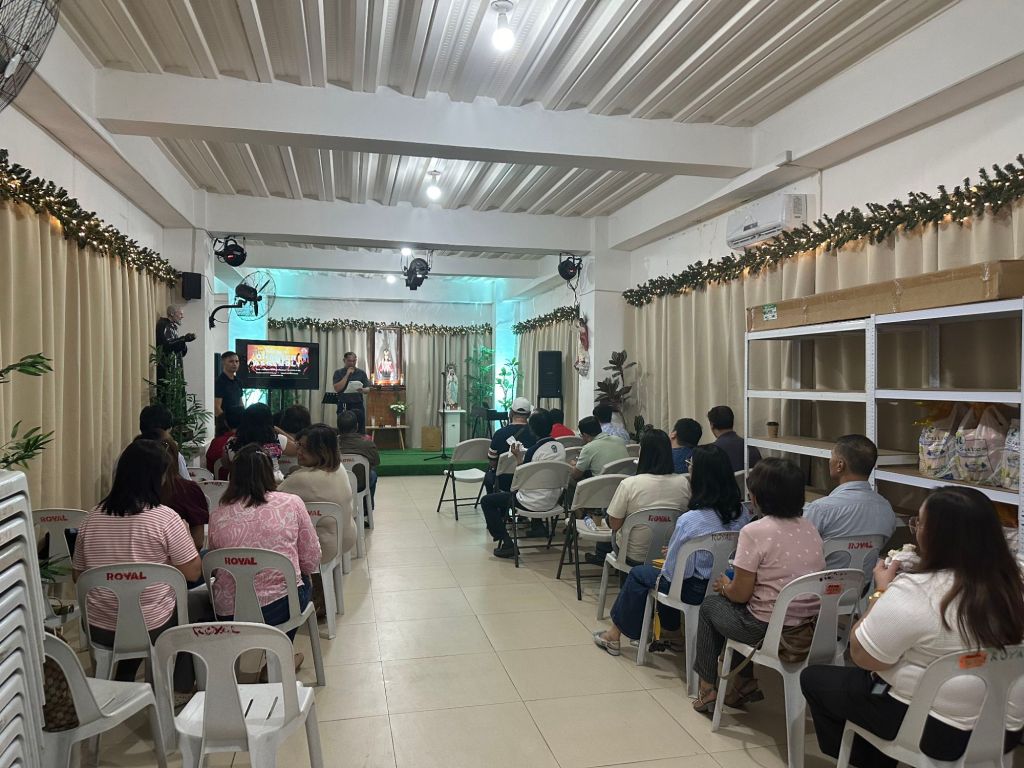
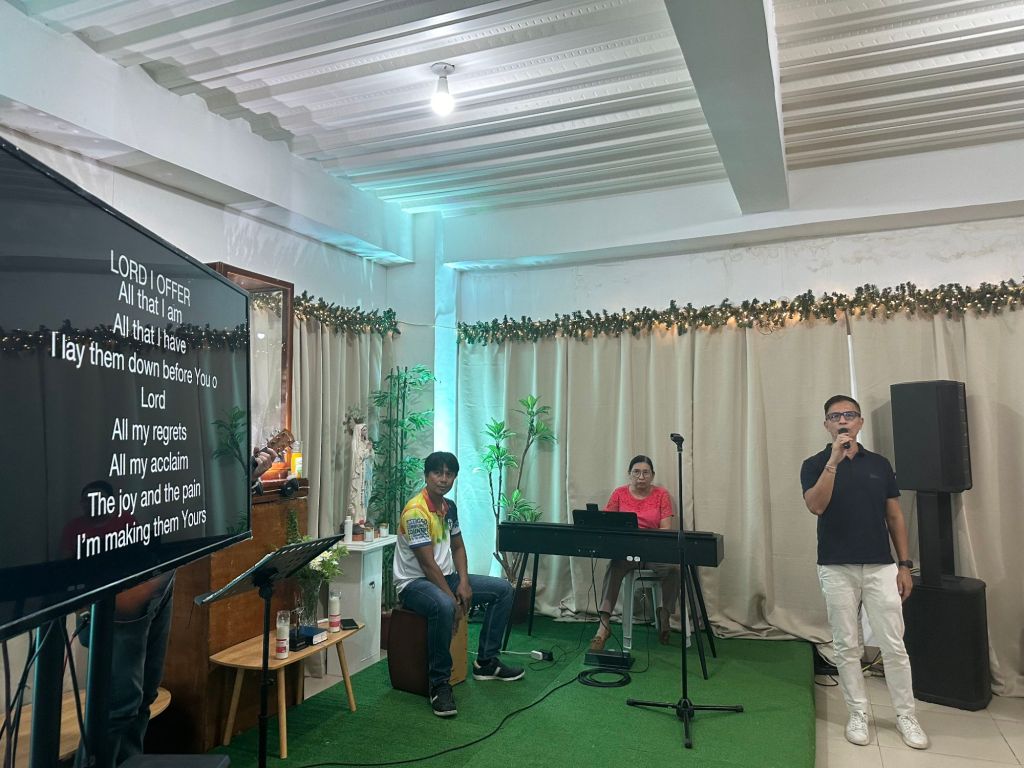
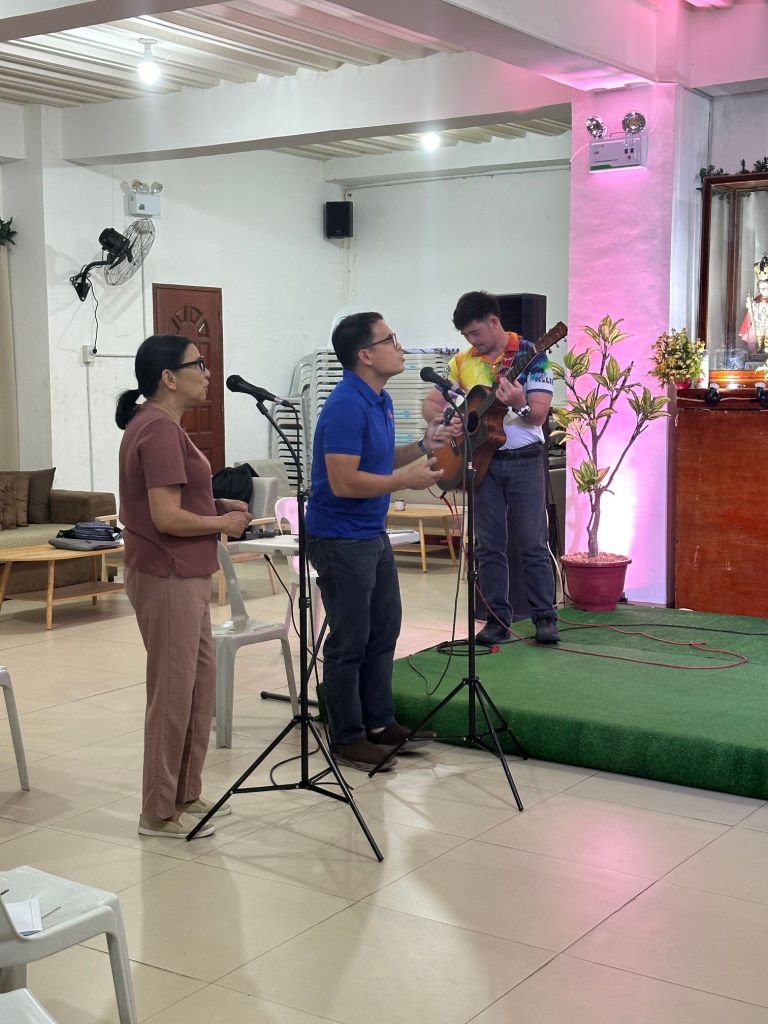
The arrangement of chairs can fundamentally alter the dynamic of a meeting. One setup promotes a sense of shared responsibility, while another reinforces a passive, performance-oriented model.
| Ideal Physical Set Up (Circle) | Less Than Ideal Set Up (Classroom Style) |
| Emphasizes participation and support. Facing one another fosters a sense of community and shared experience. | The focus is on the leader. All attention is directed to the front, creating a speaker-audience dynamic. |
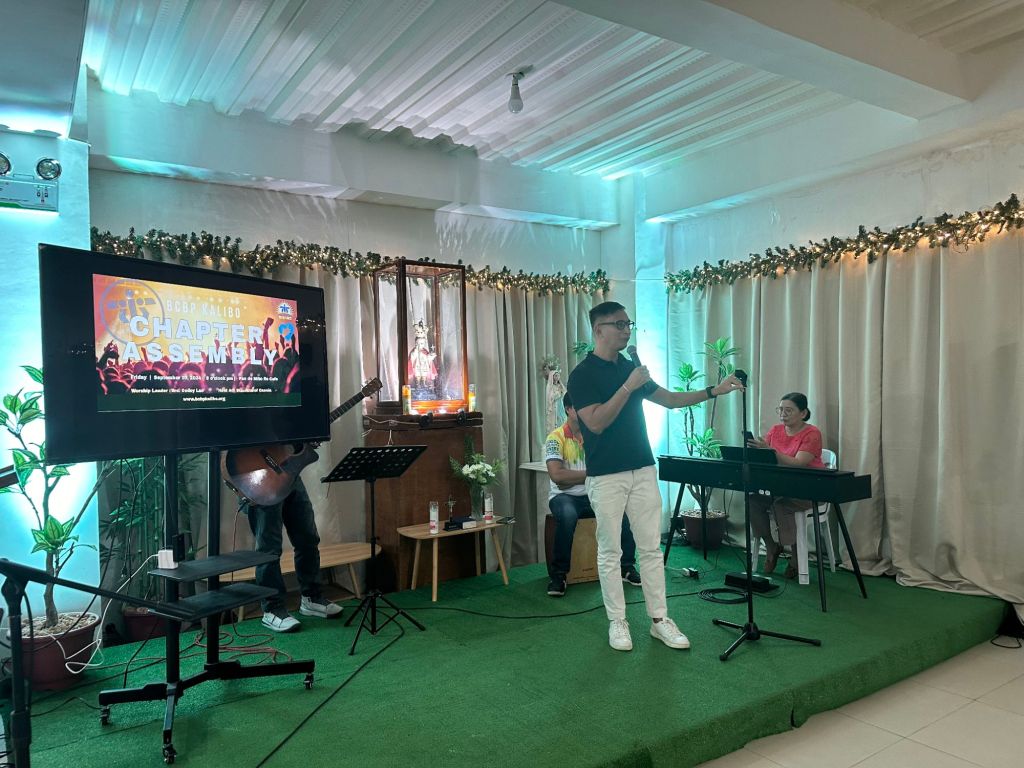
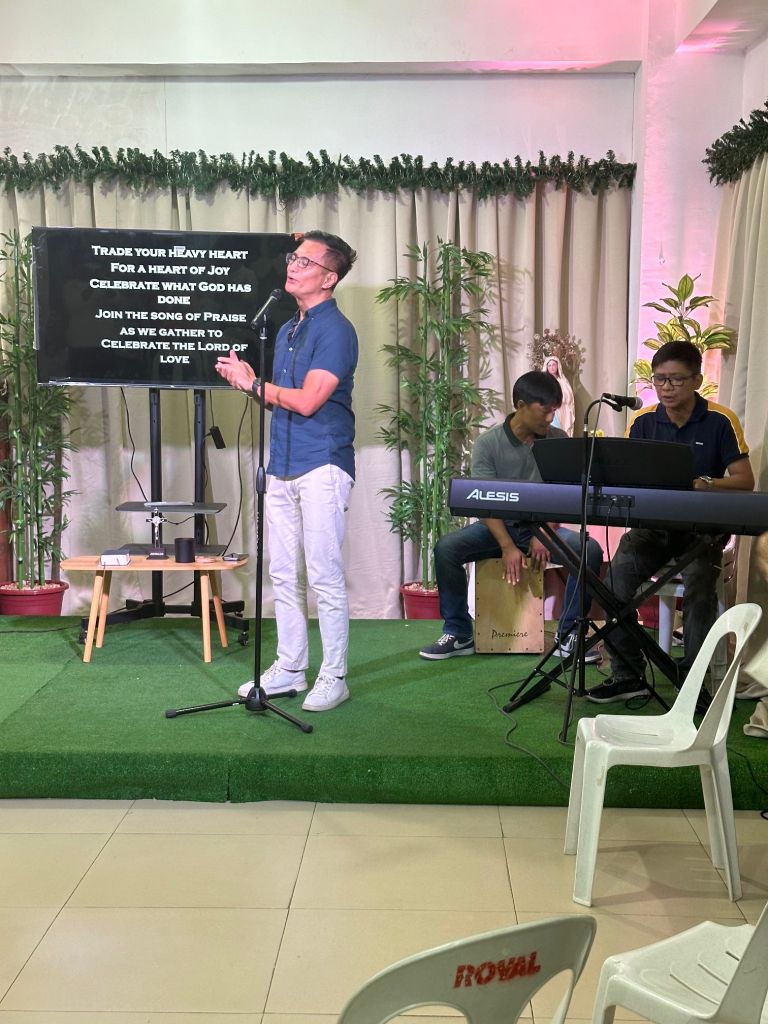
| The leader and music ministry are part of the group. They sit within the circle, as participants among participants. | The leader is often on a stage with the music ministry off to the side. This separation creates “performers” and “audience.” |
| All share responsibility for the meeting. The layout itself communicates that everyone is equally part of the gathering. | Participation is discouraged. It is physically and psychologically harder to contribute when facing the back of someone’s head. |
| Support singers are distributed within the circle. This helps spread the sound and encourages confident singing. | This setup reinforces the idea that only those “at the front” are meant to be heard. |
3.2. Actively Fostering Participation
A conducive physical layout is a great start, but it must be paired with intentional leadership. The leader has a responsibility to create a culture of participation through clear and consistent communication.
- Instruct Participants: Do not assume people know how to participate. The leader must explicitly instruct and teach members how to actively engage in praise and worship.
- Invite, Don’t Dominate: The leader’s role is to open doors for others to step through. If you are the leader, don’t take over. Instead, create pauses and verbally invite others to contribute a prayer, a scripture, or a song.
- Make it the Norm: Consistently “tell and teach their members how to participate actively in praise and worship.” Over time, this creates a community culture where participation is expected and celebrated, not seen as an exception.
With the stage set both physically and culturally, we can now turn to the actual flow and content of the meeting itself.
4. The Core Elements of a Prayer Meeting
A well-led prayer meeting has a discernible structure and flow, guiding the community through different postures of worship. It moves from an initial call to praise, into a time of active worship, then to a phase of listening to God, and finally to a period of mutual upbuilding and instruction. This section breaks down these essential components, providing guidance on how to lead each one effectively.
4.1. The Opening Exhortation
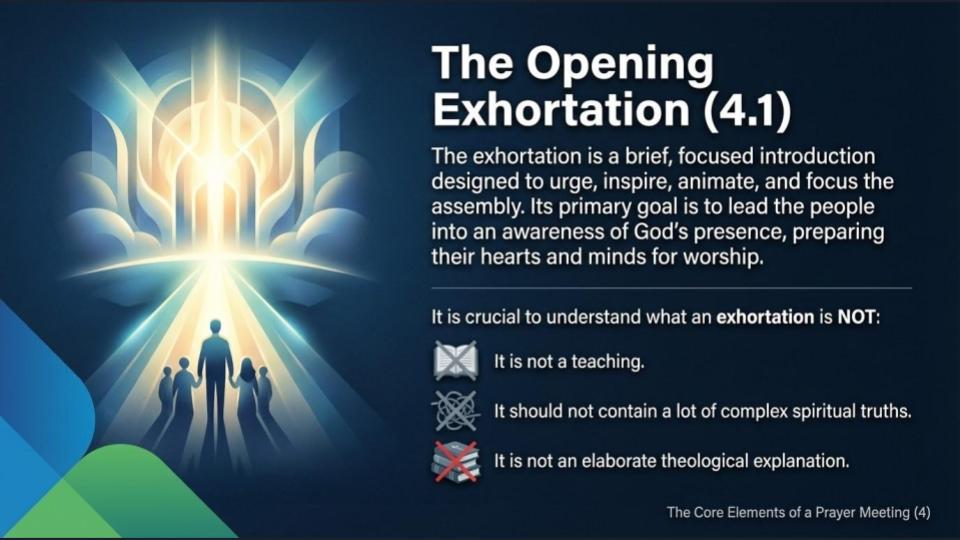
The exhortation is a brief, focused introduction designed to urge, inspire, animate, and focus the assembly. Its primary goal is to lead the people into an awareness of God’s presence, preparing their hearts and minds for worship.
It is crucial to understand what an exhortation is NOT:
- It is not a teaching.
- It should not contain a lot of complex spiritual truths.
- It is not an elaborate theological explanation.
Guidelines for the Exhortation
- Duration: It must be brief, ideally between 3 to 5 minutes. Anything over 5 minutes becomes a “sermonette” and defeats its purpose.
- Preparation: Pray and organize your thoughts beforehand. Focus on one important point and write out a simple structure (beginning, middle, conclusion).
- Content Sources: Draw material from scripture, your personal meditation, or an inspirational story (always citing the source).
- Delivery: Personalize it—do not memorize it word-for-word. Speak with conviction that comes from confidence in God, not in your own ability, and make eye contact with the people you are addressing.
4.2. Worship in Song and Spirit
Musical worship is a central element of the prayer meeting, expressed in various forms that invite the full participation of the community.
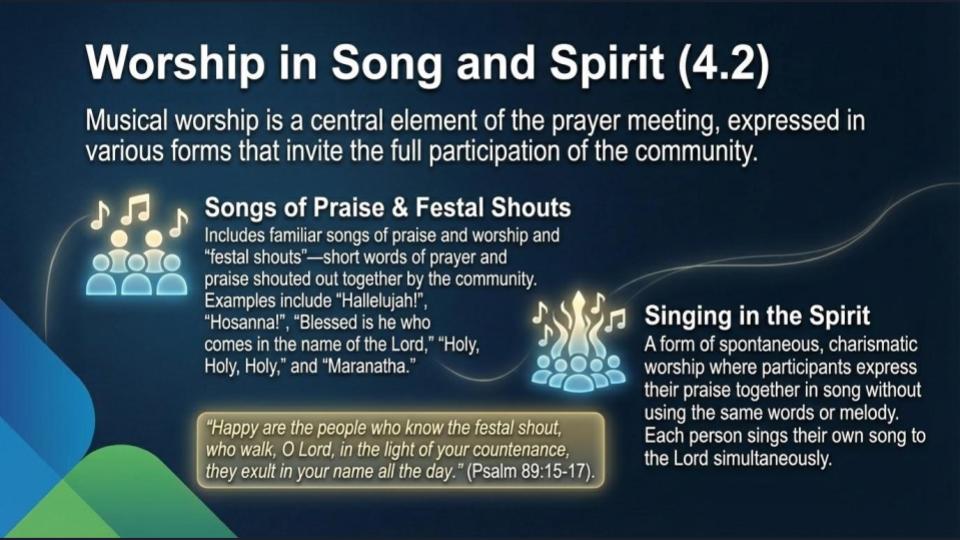
- Songs of Praise & Festal Shouts: The meeting typically includes familiar songs of praise and worship. This can be powerfully supplemented by the “festal shout”—short words of prayer and praise shouted out together by the community. Examples include “Hallelujah!”, “Hosanna!”, “Blessed is he who comes in the name of the Lord,” “Holy, Holy, Holy,” and “Maranatha.” This communal declaration is rooted in scripture: “Happy are the people who know the festal shout, who walk, O Lord, in the light of your countenance, they exult in your name all the day.” (Psalm 89:15-17).
- Singing in the Spirit: This is a form of spontaneous, charismatic worship where participants express their praise together in song without using the same words or melody. Each person sings their own song to the Lord simultaneously. The Holy Spirit then fashions these individual songs into one beautiful, common call of praise, creating a powerful experience of unified worship.
4.3. Worship in Body and Posture
Prayer is an act of the whole person—we are body and soul. Therefore, our physical posture is a powerful way to express outwardly what is in our minds and hearts. A leader can help the community engage more fully by guiding them into various prayer postures.
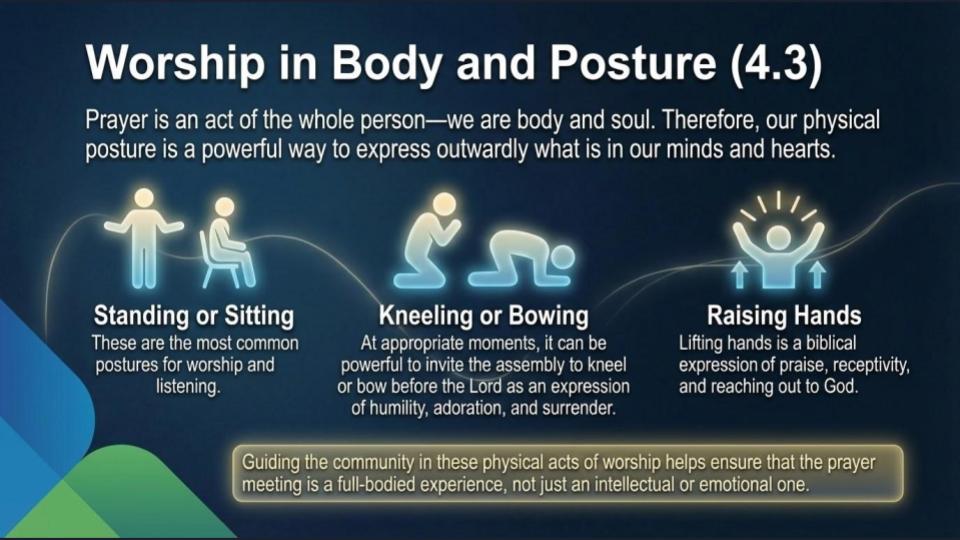
- Standing or Sitting: These are the most common postures for worship and listening.
- Kneeling or Bowing: At appropriate moments, it can be powerful to invite the assembly to kneel or bow before the Lord as an expression of humility, adoration, and surrender.
- Raising Hands: Lifting hands is a biblical expression of praise, receptivity, and reaching out to God.
Guiding the community in these physical acts of worship helps ensure that the prayer meeting is a full-bodied experience, not just an intellectual or emotional one.
4.4. Listening to the Lord and Building Up the Community
After a period of active praise, the meeting transitions into a phase of listening and receiving from God, and then sharing with one another to build up the community.
- Listening Elements: God speaks to the community during the assembly in several primary ways:
- Prophecy
- A word in tongues with interpretation
- A vision with interpretation
- Scripture
- Building Up Elements: The community is then built up through shared contributions:
- Short sharing of what God has done in a member’s life
- A short teaching
- Praying for one another’s needs
4.5. Sharing and Testimony
Sharing personal testimony is a powerful way of making God’s presence tangible in the community. When members see God in action in the lives of others, it builds faith and reminds everyone that our God is a living God.
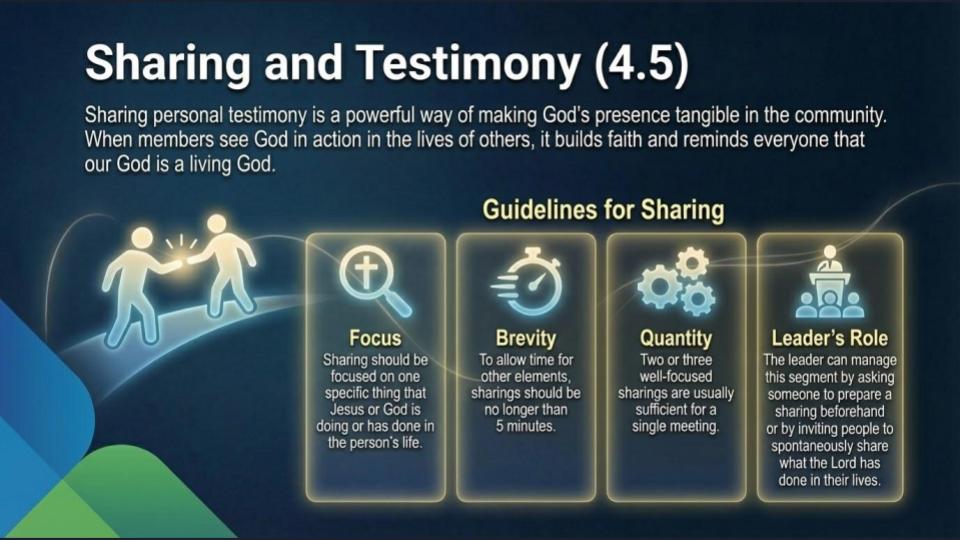
Guidelines for Sharing
- Focus: Sharing should be focused on one specific thing that Jesus or God is doing or has done in the person’s life.
- Brevity: To allow time for other elements, sharings should be no longer than 5 minutes.
- Quantity: Two or three well-focused sharings are usually sufficient for a single meeting.
- Leader’s Role: The leader can manage this segment by asking someone to prepare a sharing beforehand or by inviting people to spontaneously share what the Lord has done in their lives.
4.6. The Teaching
The teaching is a short, practical lesson given by the leader, designed to help people apply the Gospel to their daily lives.
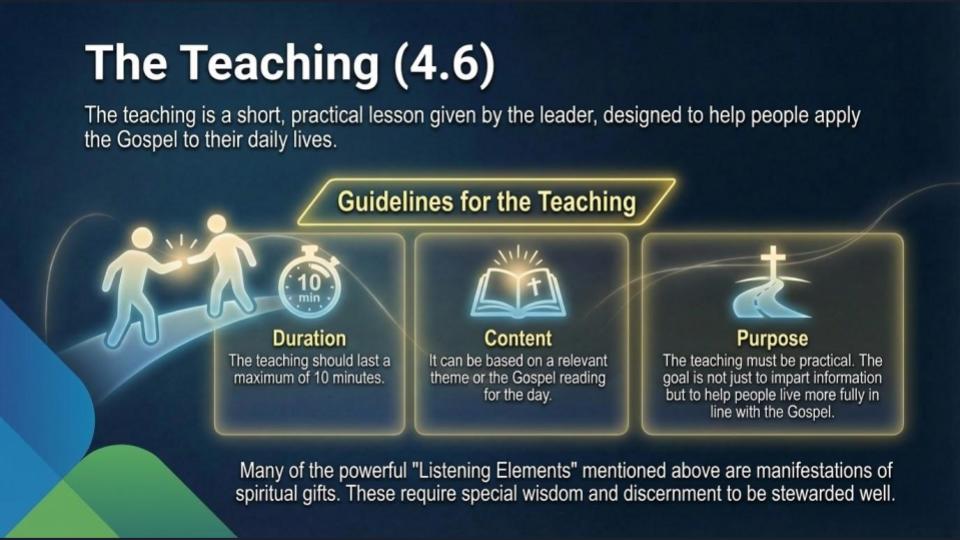
Guidelines for the Teaching
- Duration: The teaching should last a maximum of 10 minutes.
- Content: It can be based on a relevant theme or the Gospel reading for the day.
- Purpose: The teaching must be practical. The goal is not just to impart information but to help people live more fully in line with the Gospel.
Many of the powerful “Listening Elements” mentioned above are manifestations of spiritual gifts. These require special wisdom and discernment to be stewarded well.
5. Navigating Spiritual Gifts with Discernment
Spiritual gifts are vital for a vibrant, Spirit-led prayer meeting. However, they require wisdom, maturity, and careful discernment from both leaders and participants to ensure they fulfill their God-given purpose: to build up the community. This section provides detailed guidance on understanding and stewarding these powerful gifts.
5.1. The Foundation: Gifts for the Common Good
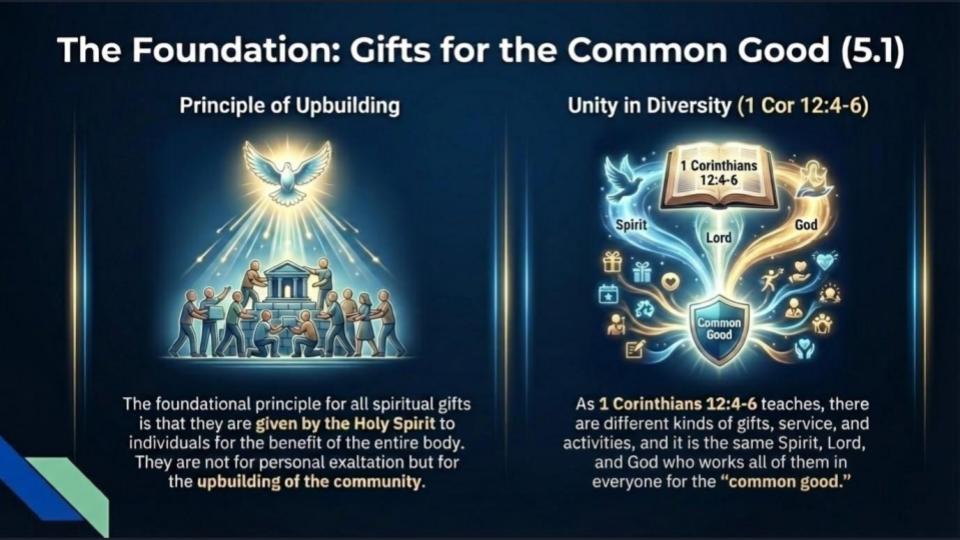
The foundational principle for all spiritual gifts is that they are given by the Holy Spirit to individuals for the benefit of the entire body. They are not for personal exaltation but for the upbuilding of the community. As 1 Corinthians 12:4-6 teaches, there are different kinds of gifts, service, and activities, but it is the same Spirit, Lord, and God who works all of them in everyone for the “common good.”
5.2. The Gift of Prophecy
Prophecy is an important gift the Lord has for His community to guide, direct, and encourage it. Its purpose is always constructive.
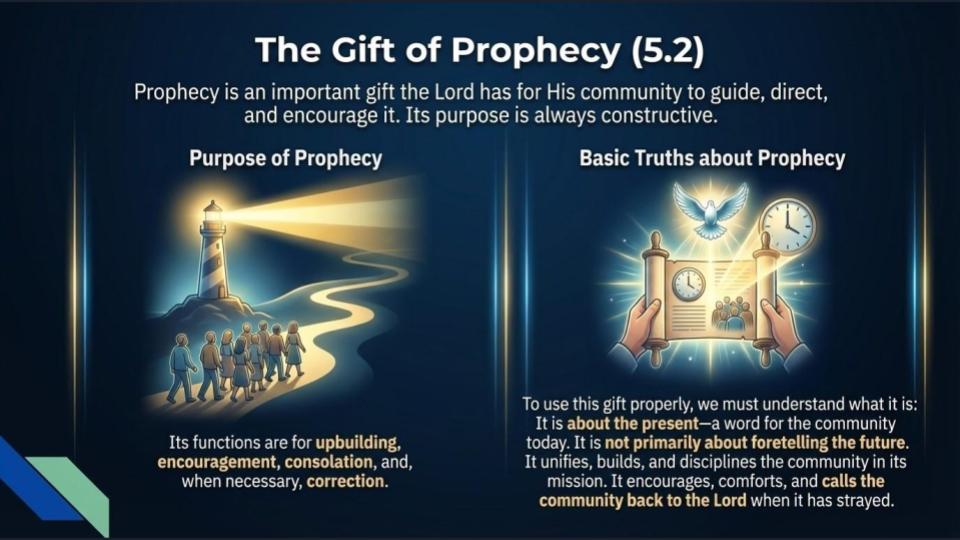
- Purpose of Prophecy: Its functions are for upbuilding, encouragement, consolation, and, when necessary, correction.
- Basic Truths about Prophecy: To use this gift properly, we must understand what it is:
- It is about the present—a word for the community today.
- It is not primarily about foretelling the future.
- It unifies, builds, and disciplines the community in its mission.
- It encourages, comforts, and calls the community back to the Lord when it has strayed.
Evaluating Prophecy
Discernment is crucial. Not everything spoken in a prophetic style is a true word from the Lord. Leaders and members must learn to distinguish between true prophecy, false prophecy, and non-prophecy.
| Marks of True Prophecy | Signs of False Prophecy | Non-Prophecy |
| Is in line with Scripture, Church teaching, and the vision & mission of the community. | Takes the Lord out of the meeting or changes the focus from Jesus. | Is someone speaking their own thoughts or feelings in the name of the Lord. |
| Reflects the direction the Lord has been giving the community. | Is not based on Scripture and may contradict Church teaching. | Example: “My people, I desire you to pray the rosary everyday. It is the very best prayer…” This reflects a personal opinion, not a word from the Lord for the community. |
| Builds up, encourages, brings joy, peace, and unity. | Disturbs the spirit of the meeting, removes peace, and creates division. | |
| Includes a call to repentance and a deeper relationship with God. | ||
| Makes the community more a community of the Lord with a specific mission. |
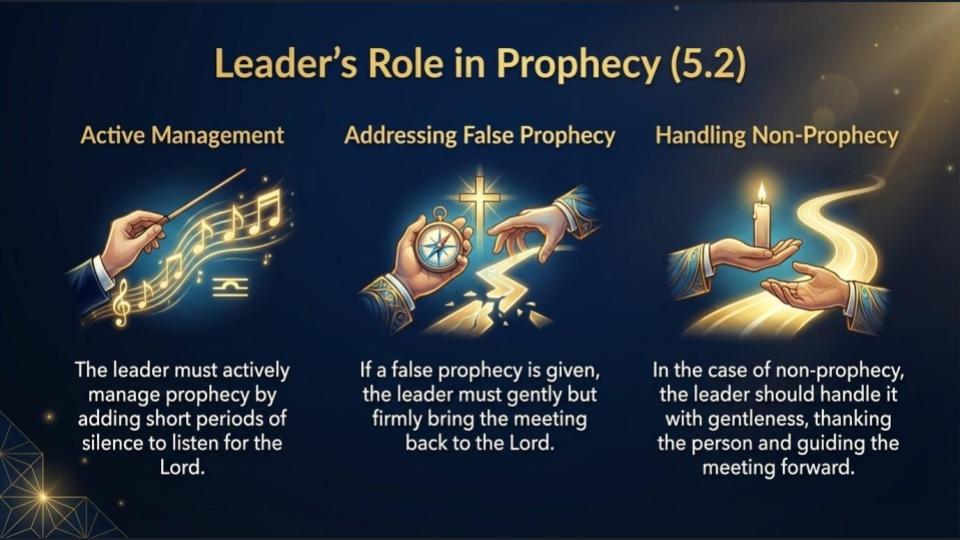
- Leader’s Role in Prophecy: The leader must actively manage prophecy by adding short periods of silence to listen for the Lord. If a false prophecy is given, the leader must gently but firmly bring the meeting back to the Lord. In the case of non-prophecy, the leader should handle it with gentleness, thanking the person and guiding the meeting forward.
5.3. The Gift of Tongues
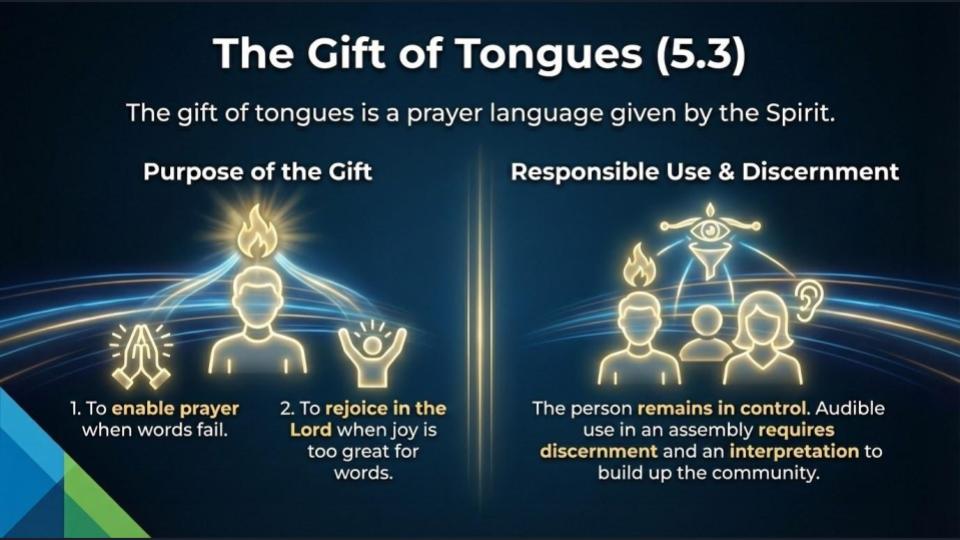
The gift of tongues is a prayer language given by the Spirit. Its purpose is twofold: to enable a person to pray when they don’t know what to say, and to rejoice in the Lord when their joy is too great for ordinary words. The person who has this gift remains in control of it and is responsible for using it correctly. When used audibly in a prayer assembly, it requires discernment similar to prophecy and should be accompanied by an interpretation to ensure it builds up the community.
5.4. The Gift of Visions
A vision is another way God can speak to the community. It might be a mental picture or image given to an individual.
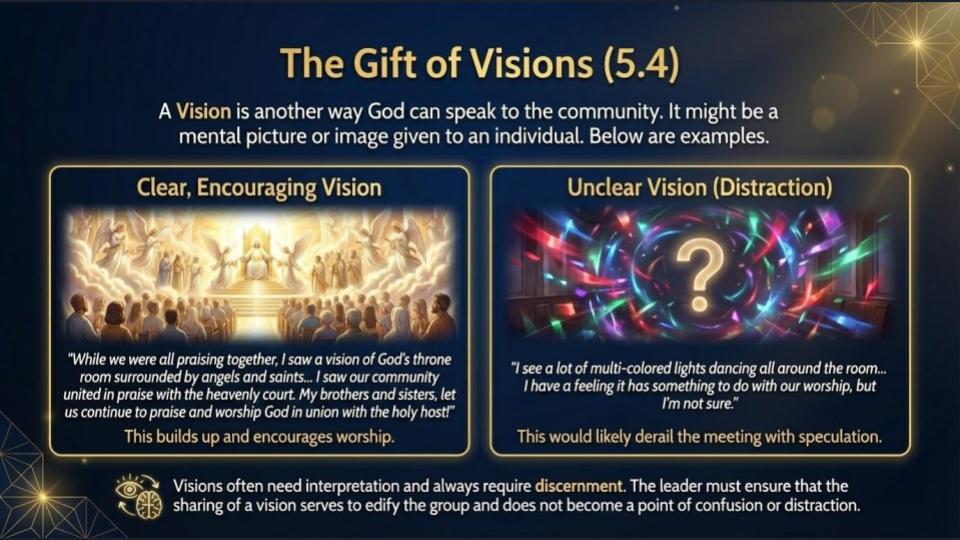
- An example of a clear, encouraging vision: “While we were all praising together, I saw a vision of God’s throne room surrounded by angels and saints… I saw our community united in praise with the heavenly court. My brothers and sisters, let us continue to praise and worship God in union with the holy host!” This builds up and encourages worship.
- An example of an unclear vision that would be a distraction: “I see a lot of multi-colored lights dancing all around the room… I have a feeling it has something to do with our worship, but I’m not sure.” This would likely derail the meeting with speculation.
Visions often need interpretation and always require discernment. The leader must ensure that the sharing of a vision serves to edify the group and does not become a point of confusion or distraction.
5.5. The Universal Call to Discernment
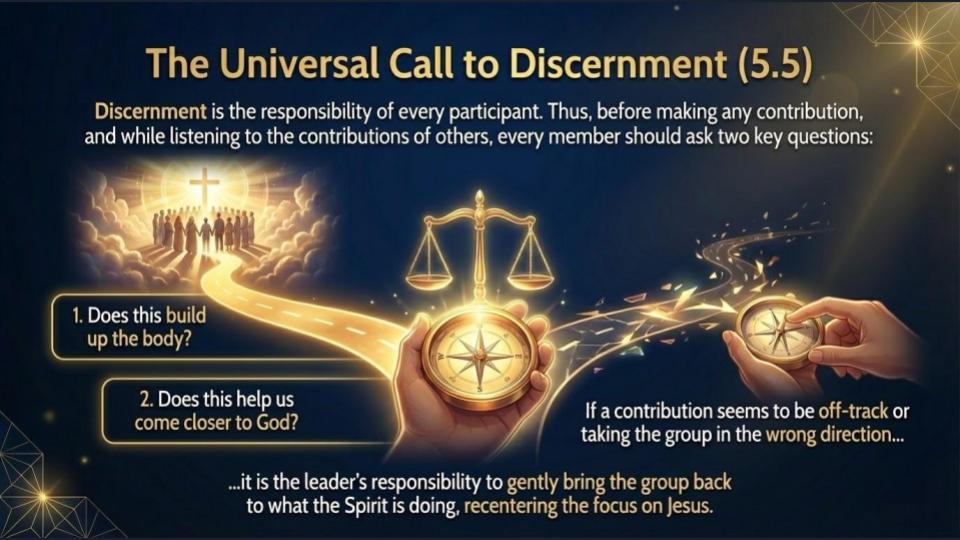
Discernment is not just the leader’s job; it is a responsibility for every participant. Before making any contribution, and while listening to the contributions of others, every member should ask two key questions:
- Does this build up the body?
- Does this help us come closer to God?
If a contribution seems to be off-track or taking the group in the wrong direction, it is the leader’s responsibility to gently bring the group back to what the Spirit is doing, recentering the focus on Jesus.
For example, imagine the Spirit has been leading the group with words about drawing near to God without fear. Then, a member stands up and reads a powerful passage from James 5: “Come now, you rich people, weep and wail for the miseries that are coming to you.” While this is the Word of God, its use in this context is disruptive. It contradicts the direction the Spirit is leading and is likely the person’s own thought, not a discerned word for the community at that moment. The leader’s job is to gently steer the focus back to the Lord’s present work.
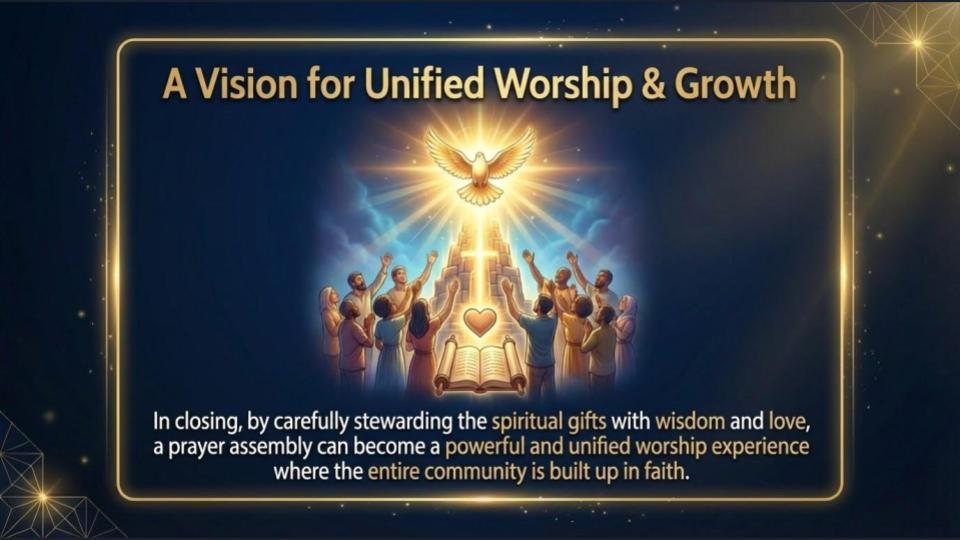
By carefully stewarding the spiritual gifts with wisdom and love, a prayer assembly can become a powerful and unified worship experience where the entire community is built up in faith.
Conclusion: Come and Participate
The charismatic prayer meeting is a vibrant, communal, and deeply participatory experience. It is a space where every person is valued, gifted, and needed to build up the body of the community in love and worship. We hope this guide has answered some of your questions and given you the confidence to join in. We invite you to come, not just to see, but to participate with an open and willing heart.


Related reading: CH Jerome G. Quimpo, A Comprehensive Guide to Spiritual Gifts published October 2,2024
ACKNOWLEDGEMENTS:
All photos open-sourced and are courtesy of the respective owners. All rights reserved.
 BCBP Kalibo Rising
You must be logged in to post a comment.